 Sport
Sport Live in-Stadia
 Sponsors
 Events
 Brands
 Agencies
 Music
Music Contests
 Web Stories
 Prizes
 Qualifying bot
 Analytics
 Audience
 Fanzone
 Blocks
 Sponsors
 Promos flash
 Membership
 Catalog
 Templates
 Penalty 3D
 Basketball 3D
 Rugby 3D
 Baller 3D
 Roue 3D
 Pronostics
 Candy Crush
 Bubble Shooter
 Piano Game
 Full services
 Contact
 Test marketing
 Integrations
 Contact
 Blog
Blog Mobile-first Ebook
 Rules generator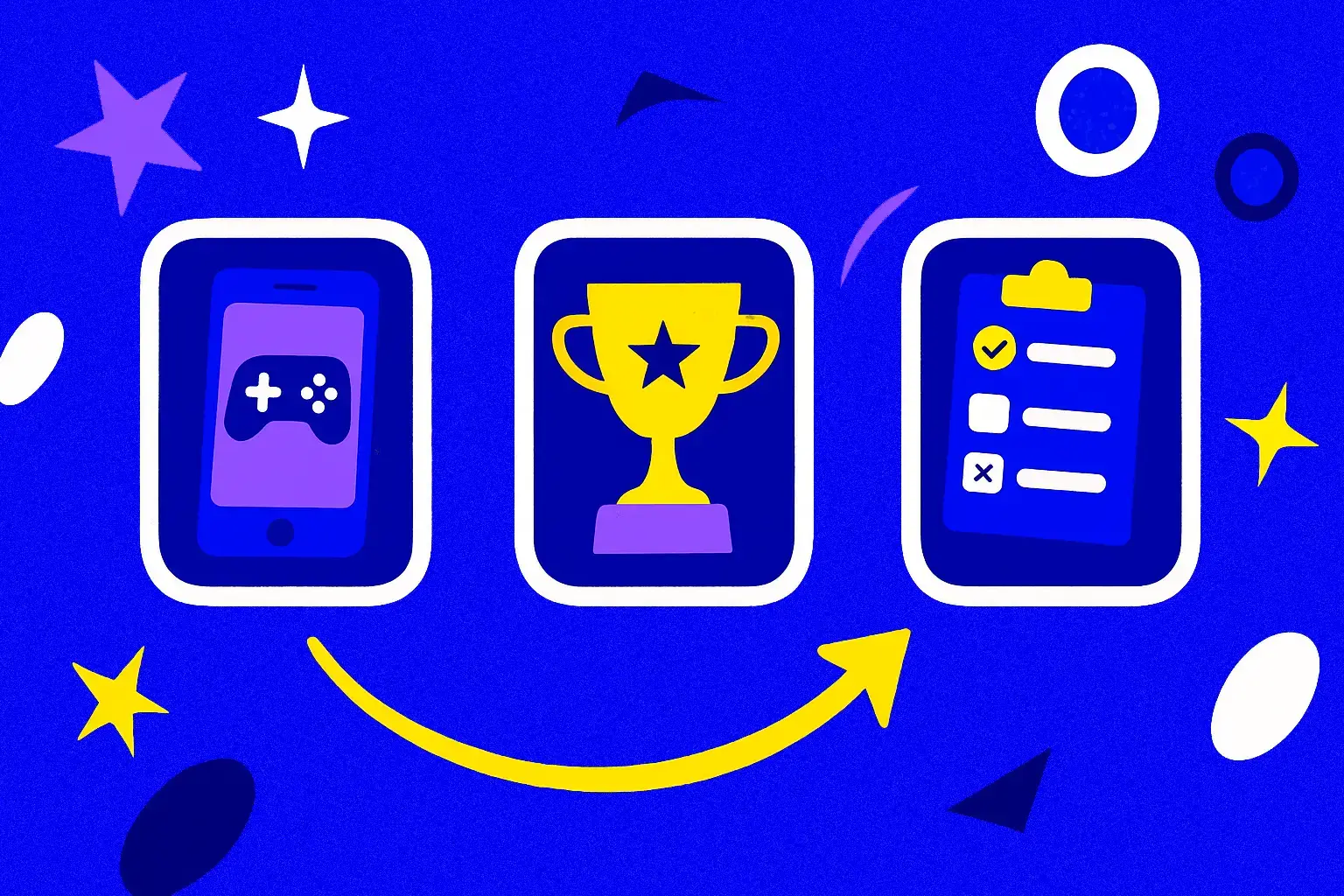

Introducing gamification into your products
Gamification has become a strategic lever to boost engagement, retention, and even conversions. But where should you start if you want to avoid a complex technical project?
According to the Casual Games Report H1 2025 by AppMagic, Puzzle, Casino, and Simulation genres account for 80% of casual game revenues, proving that easy-to-understand mechanics are the ones that attract and retain the largest audiences. This is a valuable benchmark when deciding which playful elements to integrate into your product or service.
Here are 3 practical lessons to guide you.
Focus on simplicity
The clearer the rule, the quicker users adopt the mechanic.
Practical examples
- Fitness app: a “10,000 steps” challenge with a live counter in the interface.
- Learning platform: a short quiz after each lesson to validate knowledge.
- E-commerce site: a “scratch to reveal” mini-game offering a discount.
In gaming, the success of Match-3 (Candy Crush, Royal Match) shows how a clear goal and a simple interaction can attract a massive audience.
Reward quickly
Quick rewards reinforce motivation and create a feedback loop.
Practical examples
- Marketing campaign: instant promo code after sharing on social media.
- SaaS tool: “New Explorer” badge after the first key action (upload, configuration).
- Sports event: instant virtual gift for participants in a live quiz.
In gaming, Coin Master illustrates this perfectly: every “spin” produces an immediate result, keeping the desire to replay alive.
Evolve progression
When users can see their progress, they’re more likely to return.
Practical examples
- Loyalty program: tier progression (Bronze → Silver → Gold).
- Internal training: progress bar and content unlocked step-by-step.
- Educational app: gradually increasing complexity with intermediate rewards.
AppMagic data also shows that hybridcasual puzzles (like Gardenscapes or Evony) combine simple mechanics with more strategic objectives, maintaining interest over the long term.
FAQ – Gamification for your products
How can I start gamification without coding?
With Fastory.io, you can create quizzes, mini-games, and progress bars in just a few clicks, without technical skills.
What simple mechanics can quickly engage an audience?
A lightning quiz, a one-spin “wheel of fortune,” or a visible points counter that updates in real time.
Does gamification work in B2B?
Yes, for onboarding, training, feature adoption, and internal engagement.
How do I integrate a playful mechanic into an existing product?
Start with a standalone, easy-to-test element (quiz or short challenge) and scale up based on user feedback.
Which KPIs should I track to measure gamification impact?
Participation rate, retention rate, time spent, and post-interaction conversions.
How can I adapt gamification to a diverse audience?
Offer different difficulty levels or multiple types of rewards to meet varied expectations.
📌Special Edition → From game to business: Using gamification to reach your goals
Explore how to turn playful mechanics into tangible levers for your business results.
📚 Next level → From casual to hardcore: What game pros can teach marketing
Learn how to combine accessibility with strategic depth for lasting engagement.
Sources cited
- AppMagic — Casual Games Report H1 2025: revenue breakdown by genre, highlighting the dominance of simple mechanics.